

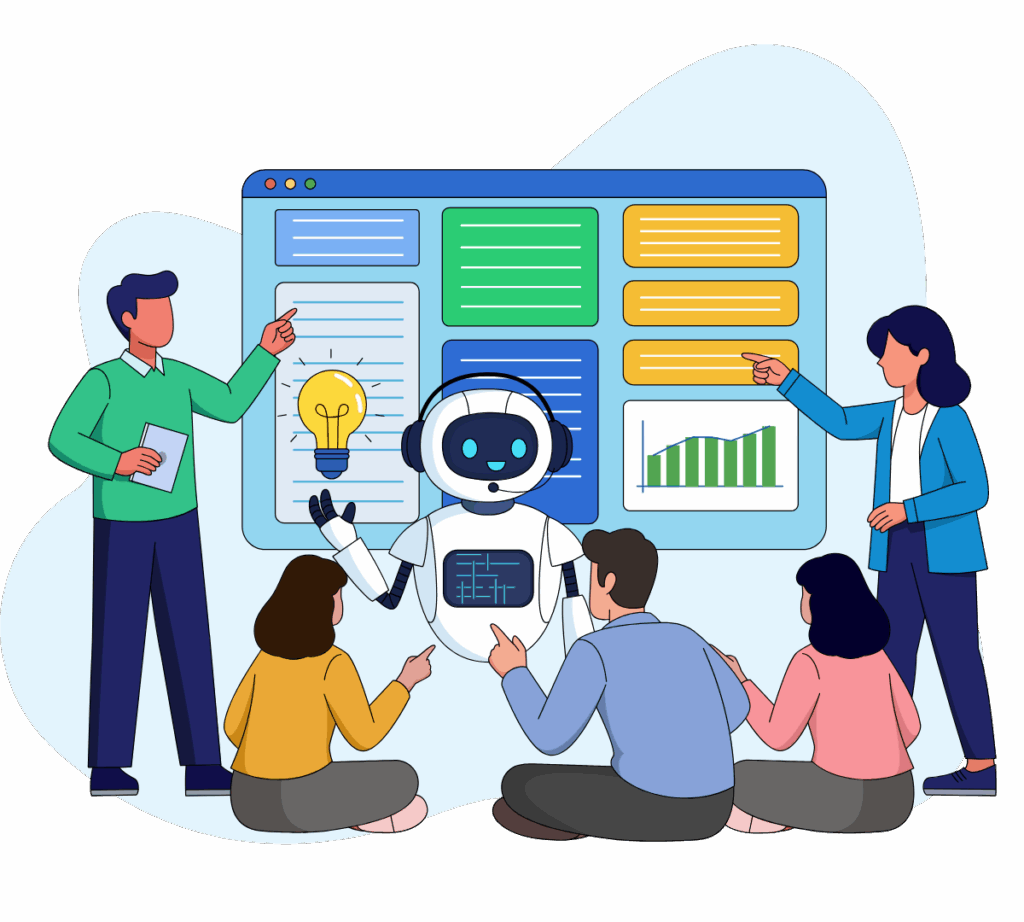
You’ve probably heard the term “AI agent” thrown around a lot lately. But what does it actually mean, and more importantly, what can it do for your business?
Let’s cut through the hype and get practical.
A chatbot follows a script. It answers pre-defined questions with pre-defined answers. If a user goes off-script, it breaks.
An AI agent is fundamentally different. It understands context, reasons through problems, and takes actions across your systems. It doesn't just respond, it thinks, decides, and executes.
Think of it this way: a chatbot is like an FAQ page with a conversation UI. An AI agent is like a new team member who can read your documents, understand your processes, and actually get work done.
The capabilities depend on how it's built and what systems it's connected to, but here are real-world examples:
Customer Support Agent
Reads incoming support tickets, understands the issue, checks your knowledge base and order system, and either resolves the issue directly or routes it to the right team with a full summary. Available 24/7, handles dozens of conversations simultaneously.
Document Processing Agent
Receives contracts, invoices, or applications, extracts key information, validates it against your rules, flags exceptions, and populates your database. What used to take a team member 20 minutes per document happens in seconds.
Internal Knowledge Assistant
Your team has questions about company policies, project status, technical documentation, or historical data. Instead of digging through SharePoint or Slack, they ask the AI assistant and get an instant, accurate answer sourced from your own documents.
Lead Qualification Agent
Incoming leads fill out a form or send an inquiry. The agent evaluates them against your ideal customer profile, enriches the data, scores the lead, and either routes hot leads to sales immediately or adds them to a nurture sequence.
Modern AI agents are built on large language models (LLMs), the same technology behind ChatGPT and Claude. But a business AI agent is much more than a generic model. It's customized with:
Your data
connected to your documents, databases, and knowledge bases through a technique called Retrieval-Augmented Generation (RAG). This means the agent answers based on your actual company information, not generic internet knowledge.
Your tools
Integrated with your CRM, email, project management, ERP, or any system with an API. The agent doesn't just talk. It takes actions in your tools.
Your rules
Configured with guardrails, approval workflows, and escalation paths. You decide what the agent can do autonomously and what requires human approval.
Ask yourself these questions:
Does your team spend significant time answering the same types of questions? Do you have processes that involve reading documents and extracting information? Are there workflows where someone is just copying data between systems? Do you have a backlog of support tickets or inquiries?
If you answered yes to any of these, an AI agent could save you real time and money starting within weeks, not months.
Building a production-ready AI agent involves several components: choosing the right LLM, connecting your data sources, building the reasoning logic, integrating with your tools, testing extensively, and deploying to a secure environment.
At EntryHub, we handle all of this end-to-end. We use Python for the core logic, Microsoft Azure for secure cloud hosting, and connect to your existing Microsoft 365 or third-party tools through APIs.
The result is an AI agent that works like a team member available around the clock, never makes the same mistake twice, and scales effortlessly as your needs grow.